
How to Build a B2B Google Ads Campaign That Converts : A Step-by-Step Guide
- Team BrandBear
- Apr 1
- 8 min read
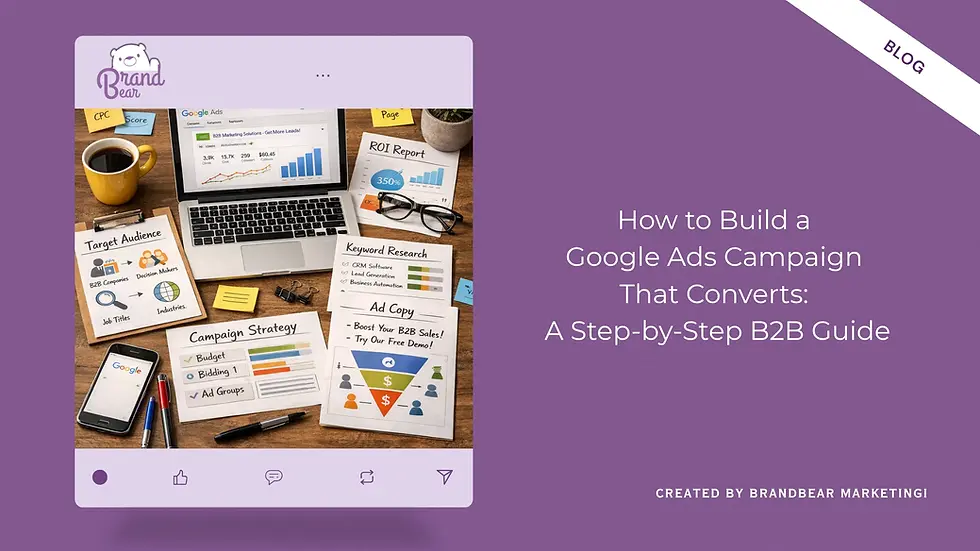
Picture this. A B2B SaaS founder sits down with her team, spends three weeks setting up a Google Ads campaign, watches the budget drain, and closes the month with exactly zero qualified leads.
The clicks were there. The conversions were not.
That story plays out every day in B2B marketing. And the reason is almost always the same: the campaign was built for traffic, not for buyers.
Google Ads for B2B is a fundamentally different beast. Sales cycles are longer, decision-makers are harder to reach, and the cost of a single wasted click is higher than most people account for. Getting it right requires more than launching ads.
It requires a system.
Here is exactly how to build that system.
What Makes a B2B Google Ads Campaign Setup Different
Most Google Ads tutorials are written for eCommerce. They focus on impulse purchases, ROAS targets, and shopping feeds.
But in B2B, you are not selling to one person. You are selling to a buying committee. And that changes everything, from your keyword strategy to your bidding logic.
According to Gartner, the average B2B deal involves 6 to 10 stakeholders. A click from a junior analyst and a click from a CFO are not equal. Your Google Ads campaign setup for B2B needs to treat them accordingly.
So, where does the real work begin?
Step 1: Define a Single, Measurable Conversion Goal
A B2B Google Ads campaign lives or dies by its conversion goal. Not five goals. One.
For most B2B businesses, that goal is a qualified lead: a demo request, a form submission, or a booked discovery call. Set this as your primary conversion action in Google Ads before you write a single headline.
Everything else, your bidding, your targeting, your ad copy, flows from this decision.
Connect your Google Ads account to Google Analytics 4 (GA4) and import your conversion events directly. Without clean conversion data flowing into the platform, the algorithm has nothing to optimize against.
Step 2: Build a Campaign Architecture That Scales
Most B2B advertisers make the same structural mistake. They throw every keyword into one campaign, create a single ad group, and wonder why performance is erratic.
The right structure separates campaigns by intent stage and product line. Use tightly themed ad groups with 10 to 15 keywords each, grouped by the problem the buyer is solving, not by your internal product naming convention.
This architecture directly improves your Quality Score. Google calculates Quality Score across three dimensions: expected click-through rate, ad relevance, and landing page experience.
A higher Quality Score means lower cost-per-click and a stronger position in the ad auction. It compounds over time. And it is one of the most undervalued levers in Pay-Per-Click (PPC) management.
A Real BrandBear Campaign Structure
A BrandBear Marketing client in the enterprise SaaS space, a workforce management platform targeting HR leaders at companies with 500 or more employees, came to us with a single campaign, one ad group, and a broad match keyword list that was eating INR 4 lakh a month with a cost-per-lead of INR 12,000.
We rebuilt the account around four distinct campaign pillars.
Campaign 1: Brand Defence. Exact match on the client's own brand terms. Separate budget ring-fenced from all other activity. This alone recovered 22% of wasted spend from competitor bidding on their brand name.
Campaign 2: Solution-Aware (High Intent). Tightly themed ad groups targeting phrases like "workforce management software for enterprise" and "HR scheduling platform pricing." Phrase and exact match only. This campaign feeds the bottom of the funnel directly.
Campaign 3: Problem-Aware (Mid Intent). Broader solution queries from buyers still defining their requirements, like "how to automate employee scheduling" and "reduce HR admin costs." Separate landing page. Separate bidding logic. Separate budget.
Campaign 4: Competitor Conquest. Targeted ads on named competitor searches, driving to a dedicated comparison landing page. Controlled spend, high intent, strong conversion rate when the creative is sharp.
Within 60 days of rebuilding on this architecture, cost-per-lead dropped from INR 12,000 to INR 6,800. Same budget. Smarter structure.
That is what campaign architecture actually does.
Step 3: Build a Keyword Strategy Around Buying Intent
Generic keywords burn budget. Intent-specific keywords close pipeline.
Focus on long-tail, high-intent search terms that signal a buyer is actively evaluating solutions. Phrases like "best B2B lead generation software pricing" or "CRM for enterprise sales teams" carry far more commercial weight than broad category terms.
Use Google Keyword Planner to surface these terms. Then layer in negative keywords aggressively to filter out researchers, students, and job seekers who will never convert.
Frederick Vallaeys, Google Ads expert and CEO of Optmyzr, has consistently argued that keyword intent segmentation is the single highest-leverage activity in PPC campaign management. Working with B2B accounts at scale, the data backs him up every time.
Step 4: Write Ad Copy That Speaks to Decision-Makers
Your headline has one job: earn the click from the right person and repel everyone else.
In B2B, that means leading with outcomes, not features. "Reduce Your Cost Per Lead by 30%" lands harder than "Advanced Marketing Platform." Include your primary keyword in at least one headline, state your value proposition clearly in the description, and close with a direct CTA.
Ad assets are not optional in a high-converting B2B campaign. Add sitelinks to your case studies and pricing pages, callout assets for proof points, and a lead form asset where budget allows.
Brad Geddes, PPC author and co-founder of Adalysis, has documented that proper asset usage lifts CTR by 10 to 15% on competitive B2B queries. And CTR is a direct input into Quality Score, so better assets pay compounding dividends.
Match every ad to its landing page. Word for word. Promise for promise. This is what Google scores as landing page experience, and it directly shapes your position in the ad auction.
Step 5: Set Up Conversion Tracking Before You Spend a Single Rupee
This is the step most teams skip. It is also the step that makes every other step actually work.
Deploy your Google Tag Manager (GTM) container and use it to fire conversion tags for form submissions, demo bookings, and phone calls. Import those events into Google Ads as primary conversion actions.
Then link your account to GA4 for behavioral data and audience building.
The ad auction rewards advertisers who send clean, consistent conversion signals. Without this infrastructure in place, Smart Bidding is optimizing against noise.
Step 6: Choose the Right Bidding Strategy for Your Stage
Here is where most B2B campaigns get the sequence completely wrong.
Start with Maximize Conversions bidding. Run the campaign until it accumulates 30 to 50 conversions. Then, and only then, transition to Target CPA (Cost Per Acquisition) Smart Bidding.
That is the moment machine learning actually has enough signal to work with.
Our Head of Performance at BrandBear puts it plainly: "Manual CPC is a control illusion. You feel like you are in charge, but you are optimizing on gut feel against an auction that processes thousands of real-time signals simultaneously. Smart Bidding does not replace strategic thinking. It replaces guesswork."
We have seen this transition deliver 50% higher conversions for clients moving from manual CPC to Target CPA Smart Bidding, once sufficient conversion data is in place. That is not variance.
That is the algorithm finding patterns a human cannot see in a spreadsheet.
Step 7: Layer B2B Audiences on Top of Keyword Intent
Search intent gets your ad in front of the right query. Audience layering gets it in front of the right person behind that query.
In Google Ads, layer Customer Match lists, in-market audiences for business software, and your website retargeting lists on top of keyword campaigns using "Observation" mode first. This lets you collect conversion data by audience segment before adjusting bids.
A BrandBear client in the B2B SaaS space, a mid-market HR technology company, reduced their cost-per-lead by 34% within 90 days simply by excluding their existing customer base from cold acquisition campaigns.
No new budget. No new creative. Just a smarter audience structure.
That is where the real opportunity lies.
Step 8: Monitor Weekly and Optimize Relentlessly
Pay-per-click is not a set-and-forget channel. Weekly reviews are the minimum standard for any B2B campaign managing real budget.
Review your Search Terms Report every week to catch irrelevant queries draining spend. Audit your Quality Score by keyword to identify where ad relevance or landing page experience is dragging performance.
A/B test headlines every 30 days. And monitor your conversion tracking health in GA4 continuously. A broken tag can corrupt your Smart Bidding data for weeks before it shows up in the numbers.
The campaigns that win in B2B are not the most creative. They are the most disciplined.
If you want an expert audit of your current setup, our performance marketing services can identify exactly where the budget is being lost and rebuild the structure around what actually converts.
Frequently Asked Questions
What is a good CTR for Google Ads B2B?
According to WordStream's industry benchmarks, the average CTR for B2B sectors on Google Search sits between 2% and 5%. A well-structured campaign targeting high-intent queries, branded terms, or competitor keywords can achieve 6% to 10%. A CTR below 1.5% on a Search campaign is a clear signal to review keyword relevance, ad copy, and Quality Score by ad group. CTR is not a vanity metric in B2B. It feeds directly into your Quality Score, which lowers your cost-per-click over time.
What is Quality Score and why does it matter for B2B campaigns?
Quality Score is Google's 1 to 10 rating of how relevant your keyword, ad, and landing page are to the user's search query. It is calculated across three components: expected CTR, ad relevance, and landing page experience. A higher Quality Score directly lowers your cost-per-click in the ad auction, meaning you pay less than a competitor bidding the same amount but running a weaker ad. For B2B, where CPCs in competitive categories can run INR 200 to INR 800 per click, even a one-point improvement in Quality Score can materially reduce your cost-per-lead over a quarter.
How long does it take for Google Ads to work for B2B?
Expect a 30 to 60 day learning period before the campaign stabilizes. The first two weeks are data collection. Weeks three and four are early signal. From week five onward, if conversion tracking is clean and the structure is sound, Smart Bidding begins optimizing meaningfully. B2B sales cycles are longer than B2C, so leads generated in week one may not close until week eight. Build your attribution model in Google Analytics 4 (GA4) to reflect that lag, or you will undervalue what the channel is actually delivering.
Should I use broad match or exact match keywords in a B2B campaign?
Start with phrase match and exact match. Broad match in B2B, without an extensive negative keyword list and without Smart Bidding fully trained, will route budget toward irrelevant queries at a rate that damages campaign economics before you can recover. Once your campaign has 60 or more conversions and Target CPA bidding is running effectively, you can introduce broad match in controlled tests, as Google's matching algorithms improve significantly with a trained Smart Bidding foundation underneath them. The Google Ads Help Center recommends this sequencing explicitly, and the data from BrandBear client accounts consistently supports it.
The Real Competitive Advantage
Every B2B company competing in Google Ads has access to the same platform. The same Keyword Planner. The same bidding strategies. The same ad formats.
But most treat it like a vending machine: put money in, expect leads out. That is not how the ad auction rewards advertisers. It rewards structured thinking, clean conversion data, and patient, methodical optimization.
And the businesses that build the system first are the ones that let Smart Bidding compound their advantage over time.
The pipeline follows. Every time.
About the Author
Gauri Lahurikar is a Founder of BrandBear Marketing, focused on Google Ads strategy, Smart Bidding architecture, and B2B lead generation. She has overseen paid search accounts across industries ranging from HR technology to fintech, with a consistent focus on reducing cost-per-lead without cutting budget.
Gauri writes on the intersection of PPC strategy, conversion tracking, and AI-driven bidding, topics she works with every day for BrandBear clients. If you want a second opinion on your current campaign structure, she and the team are easy to reach.


Comments